A Look Back at Community Activities from the Summer of 2026
Student life didn’t stop over the summer! Many students put their education into practice through internships all over the world. Others got involved in their student organizations: technical projects, student competitions, humanitarian missions… ESTACA students’ summer was full of projects and adventures!
A Scientific and Community Service Mission in Senegal with PEGASE
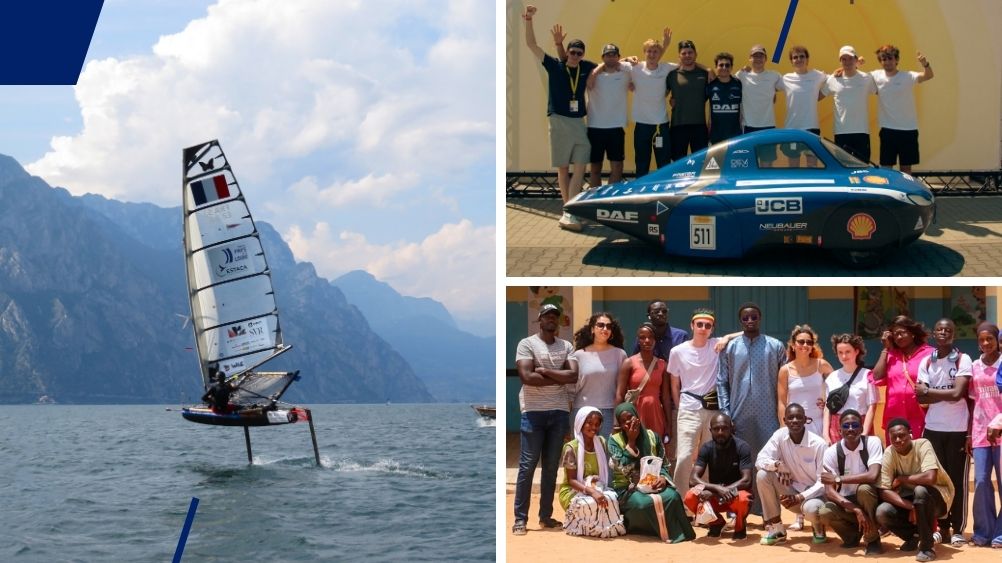
From May 31 to June 11, students from the humanitarian organization PEGASE (Project for General Awareness of Scientific Activities in Schools) carried out a mission in Senegal. The goal: to spark young Senegalese students’ interest in science by offering them a more hands-on and interactive educational experience. For two weeks, the students led science classes featuring hands-on and fun experiments at schools in Dakar (Providence Middle School and Saint Jean Elementary School) and Ngoudiane (SAHAD High School and Private School). The trip also provided an opportunity to donate scientific equipment to the schools to help them continue their scientific activities and experiments.
WAVE’s First Participation in the SuMoth Challenge in Italy
From June 8 to 14, students from ESTACA’s WAVE association participated for the first time in the SuMoth Challenge, an international competition on Lake Garda in Italy, to test their eco-designed foiling sailboat and defend their technical choices. During the week-long competition, 19 teams from universities and engineering schools around the world gathered to test the hydrofoil sailboats they had eco-designed and built under real-world conditions, in a competition that combined performance, innovation, and sustainability.
For their first time participating in this competition, the WAVE team rose to the challenge successfully. Their technical choices proved particularly promising, enabling the boat to perform exceptionally well on the lake during the regattas. The team finished in 7th place out of 19!
Shell Eco-Marathon: A Historic First for PV3e!
From June 24 to 28, students from PV3e (the ESTACA student energy vehicle project) participated in the international competition held at the Silesia Ring circuit in Poland. This competition, originally created by ESTACA students and now an international event, challenges teams to design a vehicle capable of traveling the greatest possible distance on the energy equivalent of one liter of gasoline.
With Gemini, a hybrid internal-combustion/electric urban vehicle designed to combine performance with low fuel consumption while closely resembling conventional cars, the team achieved a score of 244.6 km/L and secured third place on the podium!
“Faced with the extreme heat at the Silesia Ring and after a year fraught with challenges, it was thanks to the perseverance and ingenuity of the entire team that Gemini was able to achieve its very first competitive result and propel us to third place on the European podium at the Shell Eco-Marathon,” the team shared.
Guided Ways’ First Participation in the Railway Challenge
The weekend of June 25–28 marked the first time the Guided Ways team—made up of railway enthusiasts at ESTACA—participated in the Railway Challenge, giving them the opportunity to put their 1:5-scale locomotive on the tracks for the very first time! This international competition, held in the United Kingdom, pits teams of engineering students against one another as they design, build, and test their own locomotives while meeting demanding specifications. The vehicle’s technical performance and reliability are key to winning the various events and scoring as many points as possible. For this first competitive experience, the team successfully completed numerous stages—a highly instructive experience that will help them prepare for future editions.
The HYCE Project Has Received Multiple Awards!
Students involved in the HYCE project—run by the iDrogen association and dedicated to converting a race car to run on hydrogen—have received several awards:
– At L’Usine Nouvelle’s Grand Challenge 2026 for engineering schools, HYCE won the jury’s “Coup de cœur” award as well as second place in the Ecomobility category. The jury particularly appreciated the team’s critical perspective on hydrogen, as well as their ability to identify and articulate the challenges and limitations associated with this technology
– At the SIA Powertrain 2026 conference, the project took second place in the Student Poster Challenge.
These awards recognize the students’ hard work and dedication, while highlighting their ability to explore, in a practical way, the issues and challenges related to the mobility of tomorrow.
ESO Rockets Launched at C’Space
From July 11 to 18, 11 members of the ESO (ESTACA Space Odyssey) association participated in C’Space, the national space project launch campaign. This event is co-organized by CNES, Planète Sciences, and the French Army’s 1st Parachute Hussar Regiment. This year, three of the association’s projects qualified for C’Space:
TOTORO, a mini-rocket with parachute recovery. Inspired by an ESO project from 2007, TOTORO has six petals that deploy at apogee.
Big&Bang, a mini-rocket designed to eject its fairing at apogee. Converted into a CanSat, it takes measurements and films its descent until landing.
AURAxSPECTRA, an experimental rocket dedicated to studying aerodynamic flows during liftoff.
A great reward for the team: the TOTORO project won the award for best mini-rocket at C’Space 2026
“C’Space is a demanding technical adventure—sometimes tough, stressful, and disappointing when it comes to results—but above all, it’s a wonderful human adventure where, both within ESO and with other clubs and volunteers, we meet, build connections, and grow closer,” the students say.
The ESTACARS Single-Seater at Formula Student France
ESTACARS participated in Formula Student France from August 23 to 28 at the Transpolis circuit in Lyon. This international competition is a must-attend event for engineering students and involves designing high-performance single-seaters while developing technical and managerial skills. After a week of nonstop modifications to the single-seater, the team successfully completed a major milestone for the project for the first time: passing the mechanical technical inspection!
“Our next goal is clear: to design a battery that fully complies with the regulations so we can pass the electrical inspection next season,” says the ESTACARS team.
EFT’s Electric Single-Seater Competes in Two Formula Student Challenges in Spain and Croatia
EFT’s (Estaca Formula Team) 100% electric single-seater, the EC-O5 EVO, competed in the Formula Student competition in Spain from July 31 to August 6, and then in Croatia from August 17 to 22. During these two competitions, the car passed technical inspections but encountered reliability and electrical issues that prevented the team from finishing the races.
Nevertheless, these competitions marked historic milestones for the team, notably as they earned their first points in the autocross event with an electric car.