Develop an app for elite cyclists
The Collaborative Technology Engineering Projects (PITA) allow students to apply their technical skills to community projects. The app developed by the Roue Libre association for athletes at the Olympic Track Cycling Center is a great example of this.
Project-Based Learning at the Heart of the Engineering Program at ESTACA
At ESTACA, project-based learning plays a central role in the curriculum. Students are thus challenged with real-world problems that allow them to apply their technical knowledge while developing essential engineering skills: project management, teamwork, leadership, communication, and the ability to meet specifications….
This approach takes various forms within the school, notably through the Projets d’Ingénierie Technologiques Associatifs (PITA), which are proposed by student technical associations to address technical challenges related to the development of their projects.
A Performance Prediction App to Support Olympic Performance
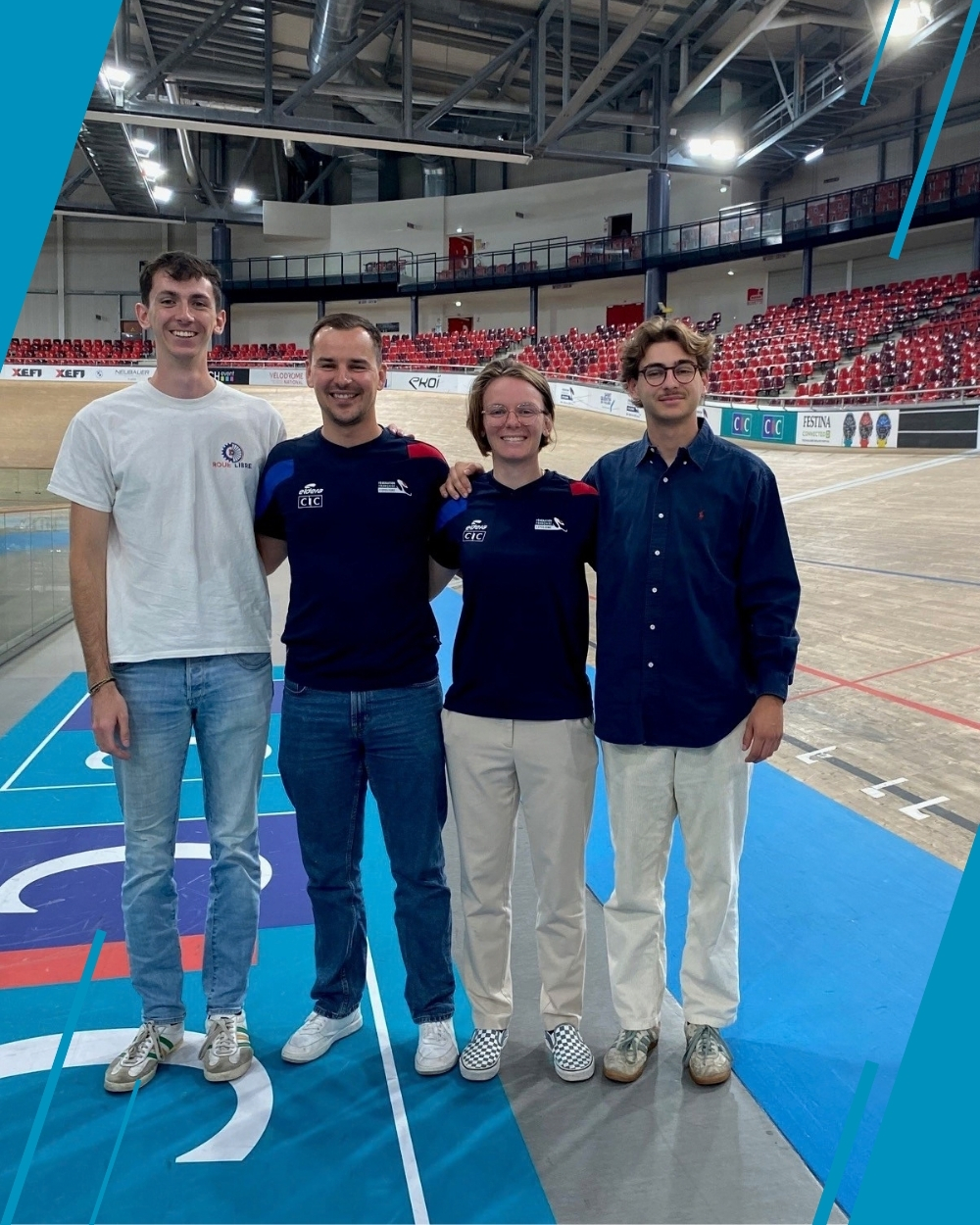
As part of a collaboration between the new Roue Libre student association at the Paris-Saclay campus and the Olympic Track Cycling Center, four students developed a performance prediction app for the center’s coach.
Thanks to an ESTACA student who is a high-level athlete and a member of the French national track cycling team, as well as the proximity of the national velodrome in Saint-Quentin-en-Yvelines, a close collaboration has developed with the Olympic training center, leading to the idea of leveraging data through artificial intelligence.
The project relies on data collected during training sessions, particularly through power sensors integrated into the bike pedals. This data makes it possible to analyze the power generated by athletes during the various phases of their training and to identify areas for performance improvement.
Rigorous data cleaning and an in-depth analysis of the correlations between variables then made it possible to identify the factors that most influence performance.
Using artificial intelligence—specifically the LightGBM algorithm, which specializes in regression problems—the students designed a performance prediction model. After several phases of hyperparameter optimization, they achieved an accuracy of approximately ±0.3 seconds in their predictions—a particularly significant achievement in a sport where every fraction of a second can make the difference and lead to international titles against other major nations in track cycling.
Going beyond simple prediction, the students Going beyond simple prediction, the students also designed a gear ratio optimization module that automatically recommends the best combination of chainring and sprocket based on track and weather conditions in order to maximize performance and achieve the best possible time.
This collaboration between ESTACA, the Roue Libre association, and the Olympic Track Cycling Center demonstrates that engineering can be a powerful driver of athletic performance.
Quentin ALBERTINI, president of the Roue Libre Paris-Saclay association and project manager, explains
“The completion of this project has demonstrated the value of artificial intelligence as a decision-support tool in the field of elite sports. The results obtained have led to the renewal of the partnership between Roue Libre and the Olympic Center for next year, with new opportunities for development focused on training prediction and optimization.”
This project, which takes into account the specific criteria of each athlete, is ongoing and ultimately aims to support French athletes in their preparation so they can actively contribute to the team’s performance leading up to the 2028 Los Angeles Olympic Games.