

Ouranos: a glider with autonomous and electric take-off
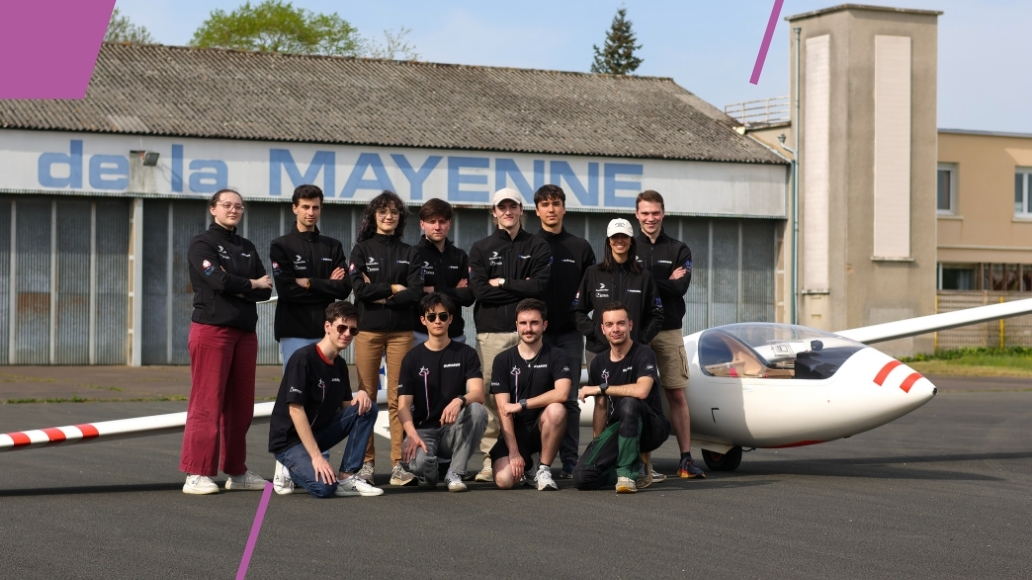
Making gliding more environmentally friendly—that is the ambition of the Ouranos project led by the Flying West student association, whose goal is to introduce students to the world of aeronautics through technical projects, activities, and events.
Around ten students from the association have embarked on the restoration and electrification of the take-off system of a two-seater glider dating from 1964, a WA-30 Bijave. The objective is twofold: to give the glider a second life and to provide an innovative solution by enabling autonomous take-off without relying on combustion engines.
An innovative technology for cleaner gliding
Gliding is an activity with very low energy impact, except during take-off. The aim is therefore to make the practice even cleaner. Until now, a glider takes off either by being launched with a winch or towed by an aircraft. The winch has become the most common solution in recent years, but Bijave gliders cannot be equipped with it, meaning many of them are no longer used.
The Ouranos project involves restoring a currently unusable glider and making it autonomous during take-off thanks to an innovative electric propulsion system.
Initially, the students are restoring the WA-30 Bijave and bringing it back to flight condition. In a second phase, they will install electric motors on each wing, fitted with foldable propellers. These motors will be placed at the rear of the wings, along the trailing edges, in order to reduce drag. This type of electric propulsion offers several advantages: it is more environmentally friendly, lighter, and less expensive than traditional combustion engines.
A comprehensive project to apply classroom knowledge
Several PITA (Student Engineering Projects) are linked to the Ouranos project. These innovation projects, proposed by student associations, allow technical studies to be integrated into the academic curriculum.
Third-year students work on cockpit weight reduction, CAD (Computer-Aided Design), motor sizing, and battery design.
Second-year students focus on the wing-mounted motor support, regulations and certification, as well as the design of winglets—devices used to improve aerodynamic efficiency despite the addition of motors.
This project enables students to put into practice the knowledge acquired during their courses, including strength of materials, system mechanics, fluid mechanics, mechanism technology, CAD, and electrical engineering.
A project with a clear roadmap
“The 2022–2023 academic year will allow us to restore the glider while progressing on the development phase through integrated engineering projects (PITA). In 2023–2024, we will install the electric propulsion system and motor mounts along with the full battery pack in the fuselage. Finally, to make the aircraft fly, a certification file will have to be submitted to the French Civil Aviation Authority (DGAC). We hope to see our glider take flight by 2025.”
Mathis
Second-year student and project manager of Ouranos