
Two ESTACA Teams at the Formula Student Competition
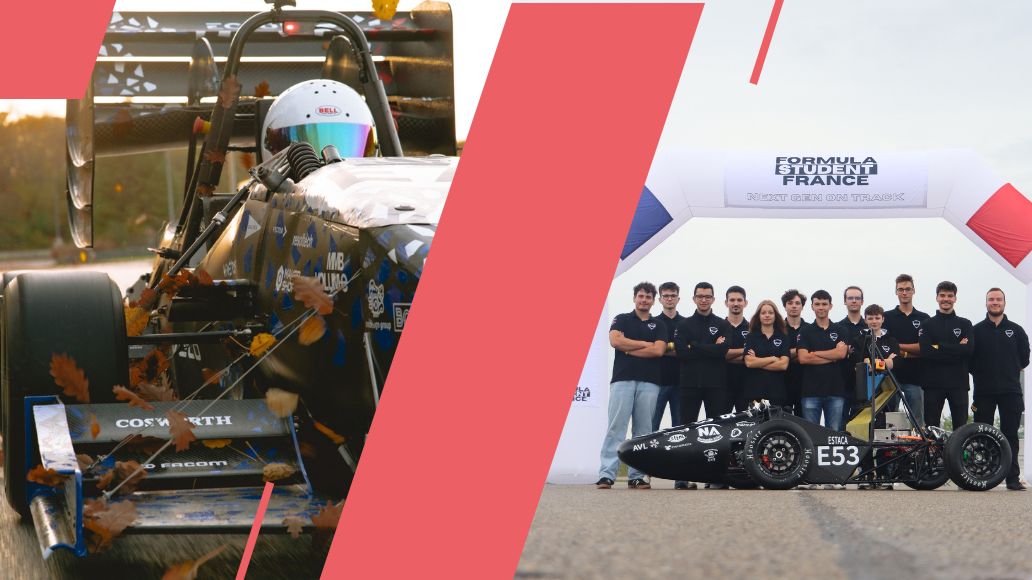
At Laval and Paris-Saclay, ESTACA students are taking on the technological challenge of designing and driving high-performance electric vehicles to compete in Formula Student. This international event is a must for engineering students, involving the design of single-seaters while developing technical and managerial skills.
Formula Student consists of several complementary events. The competition begins with static events: Design (where teams explain their technical and organizational choices), Cost (focused on budget and environmental impact), and Business Plan (where teams present their project as a business to potential investors). These events are conducted entirely in English. Next come the technical inspections, during which judges verify the vehicle’s compliance with the regulations. Finally, dynamic events include acceleration tests, skidpad (to evaluate lateral grip), endurance, and autocross. Several countries host their own competitions, each with specific regulations. This summer, ESTACARS (Laval campus) will compete in France, while EFT (Paris-Saclay campus) will participate in competitions in Croatia and Spain.
ESTACARS: A team refining its skills for Formula Student France
ESTACARS is a project developed as part of ESTACA’s curriculum, primarily for 3rd and 4th-year students, with a few 1st and 2nd-year students joining this year. Supervised by school faculty, it is an integral part of the automotive program. The team is organized into two divisions: energy & embedded systems and mechanics. Last August, about ten students competed in the French event at the Transpolis test center near Lyon. Following the jury’s evaluation, they identified necessary improvements to pass the technical inspection and participate in dynamic events. This year’s work focused on the chassis, suspension, cockpit resizing, and—on the electrical side—optimizing software for component communication. A notable innovation is the vehicle’s immersed battery, cooled by a dielectric liquid, offering better thermal efficiency but complex to implement. Beyond technical aspects, the team also strengthened communication and knowledge transfer among members, a key challenge for project continuity. “Faculty researchers guide us on certain decisions and provide expert insights, but all technical choices regarding sizing, production management, and improvements are made by the students,” explains Benjamin, a 4th-year student. After a day of quizzes on theoretical topics and competition rules, ESTACARS qualified for the 2026 edition in France (August 24–30). Due to budget constraints, the team chose to stay in France, where they will face international teams. The motivated group has increased its professionalism and aims to succeed in the technical inspection this year.
- Instagram : @estacars
EFT (ESTACA Formula Team): An electric vehicle for international Formula Student competitions
EFT’s vehicle is part of a purely associative framework. EFT is one of the largest student associations on the Paris-Saclay campus, with 78 active members from the 1st to 4th year, not all from the automotive program—including 4 drivers, 2 of whom are women! In 2025, EFT designed its first electric vehicle, competing in FS France. This participation provided valuable feedback on the vehicle’s technical aspects. Today, students are working on EC-05 EVO, an evolution of their first electric vehicle, with numerous modifications:
- Modified wiring harness,
- Completely rethought aerodynamic package (adding ground-effect side pods),
- Improved motor control (including regenerative braking). Significant work has also been done on electronics, in partnership with companies, to develop electronic boards for better reliability during competitions and full compliance with technical inspections for rolling events. The overall goal for the 2026 season and competitions in Croatia and Spain: a lighter vehicle with more sensors for better performance—and perhaps a podium finish! In parallel, EFT has begun developing an autonomous driving system in collaboration with a group of engineering students from Institut Mines-Télécom (IMT) Nord-Europe for a future vehicle. Additionally, about ten students continue to work on maintaining the last thermal vehicle, EC-04, to retain their thermal expertise, even though it no longer competes. “Associations allow us to apply theoretical skills from our courses more effectively than during an internship, as it lasts all year and over several years. The association’s workspace is highly appreciated, and EFT benefits from strong support from partner companies. This also opens doors to the alumni network. It’s a point of pride to represent the School in international competitions and showcase our expertise!” —Hadrien Veyrenc, EFT President.
With ESTACARS on the Laval campus and EFT (ESTACA Formula Team) on the Paris-Saclay campus, the school reaffirms its commitment to innovation and sustainable mobility, while offering students a concrete project management experience at the heart of automotive engineering challenges.