

ESTACA at the 2025 Paris Air Show: 100 Years of Aerospace Training
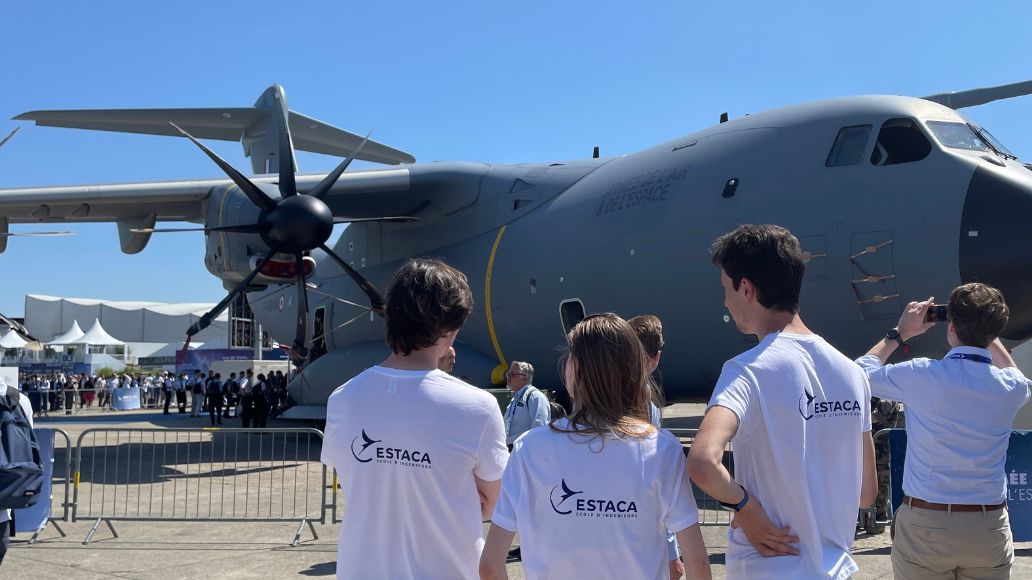
ESTACA, an engineering school specializing in sustainable transport, took part in the Paris Air Show (June 16-22), alongside other schools in the ISAE Group.. On this occasion, it is showcasing its long expertise, cutting-edge training courses and the commitment of its students to aerospace innovation.
More than 1,000 ESTACA students, from 2nd to 5th year, are currently enrolled in aeronautics and aerospace studies across the school’s three campuses. Starting in 2nd year, students can specialize, benefiting from 4 years of teaching by industry experts. In 2024, 210 aerospace engineers graduated out of a total intake of 391 students.
Innovative projects led by student associations
Lighter aircraft, reduced pollutant emissions, increased aircraft capacity, development and integration of electrical controls, development of access to space: the school trains engineers who can reconcile economic and technical performance in complete safety. Innovation at ESTACA is also based on students’ commitment to concrete, meaningful technological projects. Several of them were showcased at the Paris Air Show:
- A supersonic model airplane which plans to break the sound barrier, by the EPIC association from Laval.
- A full-scale Airbus A320 flight simulator, entirely designed by students from the Cercle Aéronautique de l’ESTACA Paris-Saclay campus.
- The Phoenix project by the association Flying West on the Laval campus: retrofitting a light 1950s aircraft with an SAF-compatible engine, to fly around France without petrol in 2027.
- Experimental rockets by ESTACA Space Odyssey (ESO): 11 mini-rockets designed and launched by student groups, from CAD to the C’Space test campaigns this summer.
- BlueProp Aero by EAGLE on the Bordeaux campus: development of innovative aeronautical solutions using hydrogen, in line with the sector’s major decarbonization challenges.
Excellent aeronautics and aerospace training on the school’s 3 campuses
Building on a wealth of expertise, ESTACA offers several courses in aeronautical mobility at its campuses in Saint-Quentin-en-Yvelines, Laval and Bordeaux. The aerospace sector is offered on its campus in the Paris region.
With its 5-year post-baccalaureate engineering program, ESTACA aims to train capable, responsible engineers with a safer, more environmentally friendly vision of the transport sector. The curriculum prepares students for current and future challenges in the aerospace industry, thanks to application projects rooted in innovation, more than 400 hours of training provided by working aeronautical engineers, and an “airline pilot” option in 4th year.
Its aeronautics courses cover:
- Aerodynamics, propulsion, structures and materials
- Avionics, on-board systems and certification
- Environmental issues: alternative engines, SAF, hydrogen.
The aerospace program is designed to give students a high level of expertise in launchers and large satellites, while also focusing on new players in the New Space sector, in response to the emergence of the new private space industry and new space applications.
Since 2024, ESTACA has been offering 5th year students a new “Innovation and Decarbonization in the Aeronautical Sector” option on its Bordeaux campus. Combining theory and practice, it aims to train engineers ready to contribute to the deployment of concrete, innovative solutions to achieve carbon neutrality and significantly reduce greenhouse gas emissions by 2030.
As part of the ISAE Group, from the start of the 2025 academic year the school will be offering a new apprenticeship in Industrial Engineering for Aeronautics and AeroSpace on the Laval campus. Offered at four sites in France – ISAE-SUPAERO (Toulouse), ISAE-ENSMA (Poitiers), ISAE-SUPMÉCA (Paris) and ESTACA (Laval) – and designed in concert with industry leaders, this program gives students key skills in aeronautical systems industrialization, aerospace science, advanced materials and applied digital technologies. Following a core curriculum common to all schools, ESTACA offers third-year students an option: Digital technologies for production and eco-responsible innovation
These courses are enriched by dual diplomas, in-company internships, close ties with the sector’s major manufacturers and an extensive catalog of continuing education courses.
A pioneering aeronautics school for a century
ESTACA was founded in 1925 and has been training future aeronautical engineers for 100 years. Backed by a unique heritage and strong specialization, the school is at the forefront of the sector’s major technological changes, from supersonic flight to the ecological transition. Evolving with the times and adapting to new challenges in the sector, the school adapts its training, projects and vision for sustainable, ambitious mobility and responsible engineers.