
VOLTA, the first electric racing car homologated to take part in the TTE
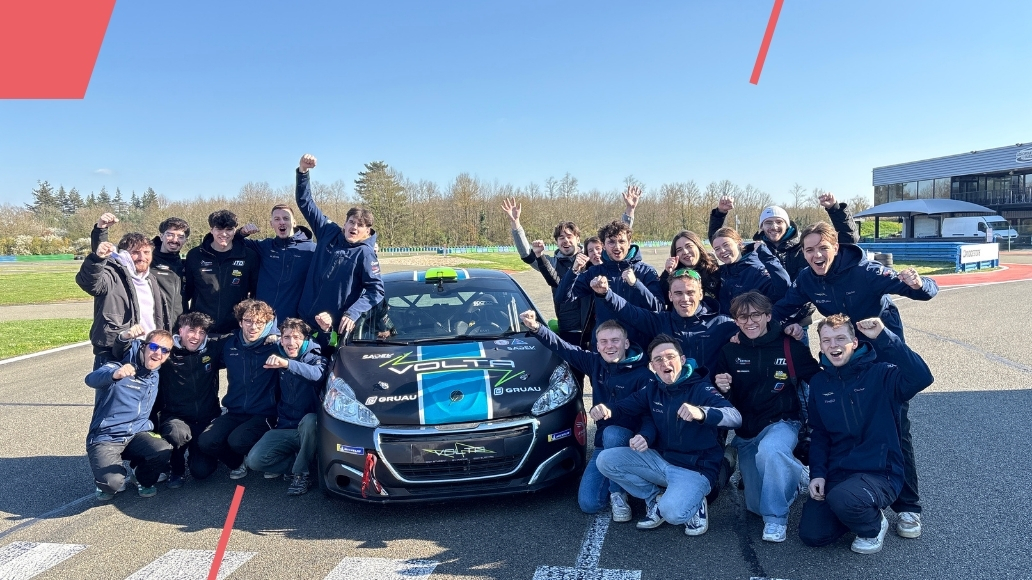
For the first time, an electric car will be taking part in the Trophée Tourisme Endurance (TTE), competing against combustion-engine vehicles in a French championship. Spearheaded by some thirty ESTACA students, the ITD association’s Volta project combines technical challenges, real-life learning and immersion in motorsports.
Volta’s electric Peugeot 208 takes on the combustion engines
The Volta project is the first FFSA-approved electric racing car (Peugeot 208) to take part in the Trophée Tourisme Endurance (TTE). This ambitious challenge, led by some thirty students, from 2nd to 4th year, has developed over three years: two years of design and engineering (2022 – 2024), followed by manufacture of the vehicle in 2024.
In 2025, the team entered the operational phase participating in the TTE championship, an essential stage for testing the car in real-life conditions, analyzing its performance and making final technical adjustments.
Volta’s first season in the Trophée Tourisme Endurance (TTE)
The Trophée Tourisme Endurance (TTE) is an amateur championship consisting of 4 sessions: two practice sessions, one qualifying session and three to four races, depending on the category. Races last between 20 and 40 minutes and take place over a long weekend, from Thursday evening to Sunday. At the start of the season, the Volta team competed in the Free Berline GT 2RD class at Magny-Cours (27) in April and Albi (81) in early May.
“Following these first two races, we applied to the championship to move up to the 208 Sprint class, in order to assess our vehicle’s performance against cars in the same class and to take part in races in safer conditions,” explain Noe Faure and Mattéo Bozet, project members and 4th-year students.
In early October, the team took part in a race at the Nogaro circuit (32), where the car demonstrated its performance and identified areas for improvement.
“To take part in this championship, we received great support from the TTE organizers, and in particular from Jean Jacques Hengel, co-organizer. He facilitated our access to the championship, allowed us to compete in a category, helped organize our arrival and offered trials… without his support, our participation would not have been possible,” Noe and Mattéo add.
Goal: make the most of real-life tests at the TTE to improve the electric vehicle
The main problems encountered on the vehicle concern battery charging and the cooling system.
“We are looking into a more efficient cooling system so that the batteries can last a whole race without overheating. We’ve identified a solution in simulation, now we just need to test it in real-life conditions on the racetrack. It’s a concrete application of our 3rd-year thermics courses,” explains Mattéo
The major advantage of the electric vehicle comes into its own at the start of the race: immediate torque gives acceleration far superior to that of a combustion engine car. The other advantages are still difficult to measure: the project is in its infancy, and this type of development requires a substantial budget. Indeed, the association is looking for sponsors!
Volta: a training project as a springboard to motorsports
In three years, the Volta project students have ensure the project will last by taking on work initiated by the founders who are today in 5th year. In traditional vehicle development, the financial, human and time resources involved are considerable. Before a final product can be produced, engineers have to go through numerous phases of testing, correction and improvement.
“In engineering, every problem requires time, reflection and often several attempts before the right solution is found. We test, we correct, we start again… Over and above our technical skills, Volta teaches us how to manage a project by working as a genuine engineer,” say Noé and Mattéo.
From their adventure with Volta, students will mostly remember the rich encounters: real team spirit, technical exchanges with fans and professionals from all over Europe, and numerous contacts made on the TTE circuits.
They also discovered behind the scenes in motorsports: track safety, marshals, coordination… For many, Volta was their first experience of motor racing and a real gateway to the world of motorsport.
With no previous experience, they were able to secure internships in GT3, single-seater or other categories. The project proved to be a great springboard to opportunities in motorsport.
ESTACA plays an essential role in this success, providing material support, workspaces and equipment, as well as a network of alumni with a strong presence in the industry. “Without Volta and ESTACA, it would have been much more difficult to get into motorsports,” point out Noé and Mattéo.
Going forward, the team aims to increase the number of track days on the circuit, in order to achieve vehicle performance. The vehicle’s reliability has been proven, and now the team wants to focus on performance!